
Science of Urinalysis - Ketonuria
Download PDF
What is Ketonuria?
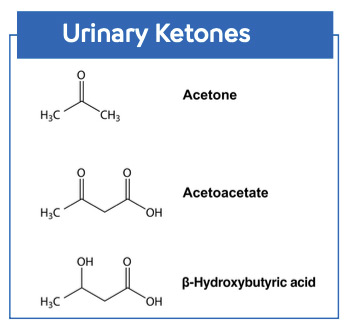
Ketones in the urine, or ketonuria, is an indication of fatty acid metabolism. Fats may be used by cells for energy when carbohydrates aren’t available, and ketones in the urine may be an indication of a pathologic process. Small amounts of ketones can show up for everyday reasons, such as fasting, following a low-carbohydrate or “keto” diet or intense exercise. More serious causes of ketonuria include diabetic ketoacidosis (DKA), starvation, and alcoholic ketoacidosis.
Urine ketones can be checked with a simple urine test strip. Reagent strip testing uses the sodium nitroprusside reaction, which detects acetoacetate, one of the three main ketone bodies that are produced by the liver and the initial molecule produced during fat breakdown. In DKA and alcoholic ketoacidosis, 3-beta-hydroxybutyrate (3HB) is the predominant ketone body present, but it is not detected by most test strips until it naturally converts back to acetoacetate. For this reason, routine urine testing can underestimate the true ketone levels and serum 3HB may be recommended for monitoring patients being treated for DKA.
At-home ketone testing that is available for patients with diabetes includes urine ketone test strips and blood ketone meters. Testing for ketones may be indicated when a patient’s blood glucose levels are high (>250 mg/dL), they are experiencing nausea or vomiting or they become confused. DKA can happen quickly and is a life-threatening medical condition.
Resources:
Laffel L. Ketone bodies: a review of physiology, pathophysiology and application of monitoring to diabetes. Diabetes Metab Res Rev. 1999 Nov-Dec;15(6):412-26. doi:
10.1002/(sici)1520-7560(199911/12)15:6<412::aid-dmrr72>3.0.co;2-8. PMID: 10634967.
https://medlineplus.gov/lab-tests/ketones-in-blood/. Accessed 9/30/2026.
Sigue leyendo Download PDF