Hemostasis - Fibrinogen: A Key Player in Blood Clot Formation
Download PDF
Fibrinogen is one of the most important proteins in human blood, serving as the essential raw material the body transforms into fibrin—the structural “mesh” that stabilizes blood clots. Although it receives far less public attention than cholesterol or glucose, fibrinogen is central to how the body stops bleeding and responds to injury.
Synthesis and Circulation
Fibrinogen is produced in the liver and circulates in plasma in a soluble form. Under normal conditions, it remains inactive, ready to be rapidly converted when needed. Because its production increases in response to inflammation or physiological stress, fibrinogen is considered an acute phase reactant—meaning levels can rise during infection, pregnancy, obesity, or chronic disease.
Role in the Coagulation Cascade
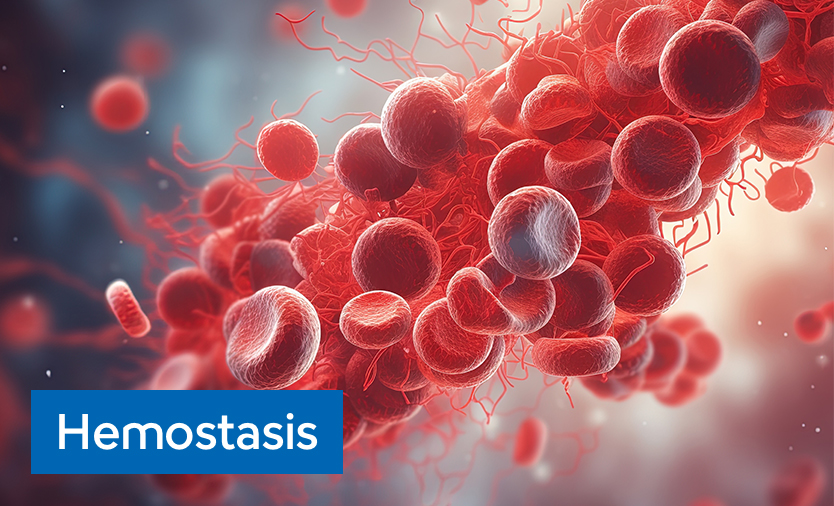
When blood vessels are injured, the enzyme thrombin plays the key role of converting fibrinogen into fibrin. Thrombin removes fibrinopeptides A and B, triggering the exposed binding sites to link together and form a fibrin mesh; this, in turn, provides structural support to the initial platelet clot by forming a scaffold-like structure around the platelets.
However, this initial polymerization of fibrin is unstable and requires factor XIII to cross-link the fibrin to form a stable structure (Figure 1). Subsequently, the trapped platelets migrate out of the fibrin mesh and are replaced by red blood cells, which are tightly packed after clot retraction. The end result is a very stable and solid red clot that seals the injury for wound repair.

Clinical Significance
Abnormal fibrinogen levels, whether too low or too high, provide important diagnostic clues.
When fibrinogen levels are low, patients may experience excessive bruising, prolonged bleeding, or even life threatening hemorrhage. Decreased fibrinogen levels may indicate:
- Liver disease – fibrinogen synthesis may be reduced.
- Disseminated Intravascular Coagulation (DIC) – unregulated activation of the coagulation system leads to an increased consumption of clotting factors, including fibrinogen, which is used up for fibrin and clot formation.
- Dilutional coagulopathy – large volume blood transfusions following massive blood loss may dilu
- Genetic disorders – inherited fibrinogen deficiencies such as afibrinogenemia, hypofibrinogenemia, or dysfibrinogenemia can be either quantitative or qualitative. Patients may be asymptomatic, have mild or severe bleeding or even present with thrombosis.
Because fibrinogen acts as an acute phase reactant, it is often more difficult to correlate increased levels with specific disease states. Elevated fibrinogen levels are commonly seen in:
- Inflammation
- Infection
- Pregnancy
- Obesity
- Chronic disease
How Fibrinogen Levels Are Measured
Laboratories assess fibrinogen using several approaches. These tests help distinguish between reduced fibrinogen quantity and impaired fibrinogen function—an important distinction in diagnosing congenital disorders and managing critical illnesses.
- Clauss functional assay – Clauss fibrinogen is a functional assay based on fibrin clot formation. The clotting time that is obtained for the diluted patient plasma sample, following the addition of high concentration of thrombin (typically 100 U/mL), is compared to a calibration curve. Clauss assay is performed on diluted plasma minimizing the interference of any substance that may inhibit the conversion of fibrinogen to fibrin, such as heparin, DOACs or elevated levels of FDPs. The high thrombin concentration in the assay ensures accurate clotting times over a broad range of fibrinogen levels.
- Antigen testing – Fibrinogen antigen testing is an immunoturbidimetric method based on the antigen- antibody reaction between fibrinogen antigens in the sample and fibrinogen antibodies bound to latex particles, resulting in latex particle agglutination. This agglutination can be detected by a change of absorbance, which is directly proportional to the amount of fibrinogen in the sample.
- Clot based or viscoelastic tests (TEG/ROTEM) – These are whole-blood, point of care tests used frequently in trauma and surgery. They assess clotting in real time, including the fibrinogen component of clot strength.
Sigue leyendo Download PDF