
Innovative Hemostasis Solutions by Sysmex: Routine & Specialty Testing
Download PDF
Hemostasis testing has experienced a dramatic change over the last 50 years. Since the 1950’s up to the early 1990’s, coagulation tests were performed manually by many laboratories. Reagents were manufactured by the laboratory staff of larger hospitals by processing animal or human brains in a batch wise fashion. These reagents were then used in the respective coagulation test such as prothrombin time (PT), activated partial thromboplastin time (APTT) and other global coagulation tests. Equipped with a centrifuge, a stopwatch, a pipette, a water bath and a test tube, the laboratory staff used these ‘in-house’ reagents to determine the clotting capability of a patient sample1.
Through the 1990’s to the early 2000’s, semi- automated and fully-automated instrumentation arrived in the hemostasis laboratory, allowing for testing improvements through standardized processes like aspiration and dispensing of sample and reagents, mixing regimens and measurement determination. During this time, analyzers using optical end-point clot detection for clot-based tests were improved upon, and colorimetric and immunoturbidimetric testing could be supported on the same platform, thereby delivering higher productivity and workflow from an automated coagulation analyzer. By the early 2000’s, reagent quality (and therefore, test results) also improved through increased standardization in reagent manufacturing.
The Sysmex CN-Series™
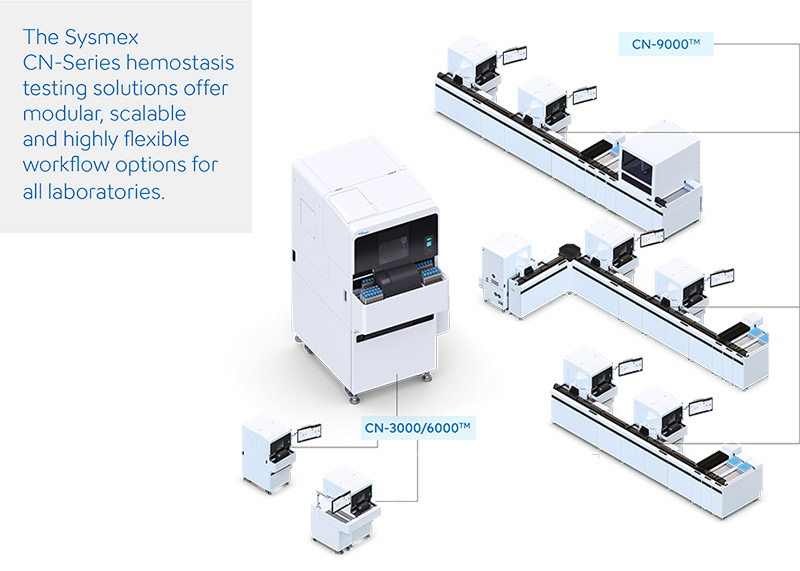
In 2025, Sysmex America, Inc., a leading diagnostic solutions company offering hematology, hemostasis, urinalysis, flow cytometry and informatic solutions, received FDA clearance for the Sysmex CN-Series Automated Blood Coagulation Analyzers. Both the CN-3000™ and CN-6000™ were launched thereafter to ensure that laboratories of any size are provided with a solution that meets their throughput requirements and size constraints. Both systems, identical in size and shape, have a smaller footprint than the current Sysmex CS-5100™ analyzer.
For low to mid-volume laboratories, the CN-3000 provides a throughput of 225 PT or 215 PT/APTT tests per hour. For medium to high-volume laboratories, the CN-6000 provides a throughput of 450 PT or 401 PT/APTT tests per hour. Features such as closed- tube sampling, Preanalytical Sample Integrity (PSI™) checks and hemolysis, icterus and lipemia (HIL) checks are performed to minimize manual handling, reduce error risk and boost overall productivity. The CN- Series systems also include gain switching analysis for reduced assay interference, allowing these analyzers to automatically switch the wavelength for detection, minimizing the effect of interference from samples with high intralipid concentrations2 .
Sysmex CN-9000™ configuration helps labs of all sizes, automate and optimize workflow
Few diagnostic companies keep pace with Sysmex when it comes to product development and the introduction of new, innovative analyzers. Across the business fields of hematology, hemostasis and urinalysis, Sysmex has a rich history of pioneering products that have transformed workflow in the clinical laboratory. The CN-Series offers new hardware, improved software and the introduction of specialized automation to the hemostasis lab. Borrowing from the ‘automated line’ concept introduced by Sysmex hematology systems, the CN-9000 configuration gives laboratories new options in maximizing workflow and resource utilization.
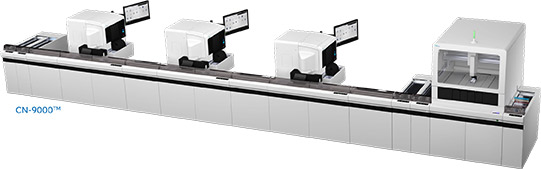
Combining high throughput and elevated efficiency, the CN-9000 configuration streamlines the hemostasis laboratory with continuous sample loading and automated rerun and reflex testing. Delivering a throughput of up to 1,000 samples per hour, labs may run the CN-9000 configuration as a standalone automation solution or connect it to a compatible total laboratory automation (TLA) line. The modular CN-9000 configuration supports up to three CN- 3000 or CN-6000 Blood Coagulation Analyzers as well as the optional Sysmex TS-10™ Integrated Tube Sorter and Archiver. The line can be configured with up to two turn unit modules, allowing 90° turns to the left or right, making it a practical fit for coagulation departments with space constraints.
The Sysmex CN-9000 configuration provides increased walkaway time with intelligent sample routing that knows which tests are available on each connected CN-Series analyzer, ensuring that each system works to its maximum capacity and that turnaround times are minimized. The reliability of Sysmex track automation, together with innovative components like turn units, means that ‘island’ automation is, for the first time, a realistic option for laboratories of all sizes, and not just reserved for large workload sites.
Unique testing capabilities
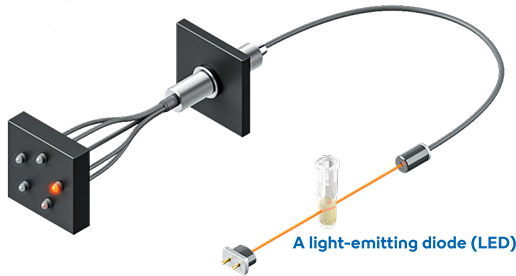
The CN-series works on the optical detection principle used by >80% of the global hemostasis market. Sysmex refined this technology by providing a multi- wavelength detection system using transmitted light to allow simultaneous analysis of clotting, chromogenic and immunoassays.
Turnaround times for clotting assays are improved over previous-generation systems. Time interval endpoint checking improves the ‘time to result’ by approximately two minutes per test while maintaining the unique feature of pre-sample warming prior to analysis. In 2021, Nguyen et al. demonstrated that the Sysmex CN-6000 provided a 30% higher throughput compared to the Stago STA-R Max2 analyzer (258 vs. 185 tests per hour for a panel of tests including PT, APTT, Fibrinogen, Factor V, anti-Xa, and D-Dimer)3 .
Hardware and software improvements on the CN- Series are designed to reduce hands-on time for your staff and increase reliability of the system.
- A light-emitting diode (LED) light source reduces operator maintenance and increases system reliability.
- Reduced sample volume requirements provide successful automated rerun, reflex and specialty testing
- Enhanced cooling systems allow increased onboard stability for reagent, QC and calibration materials
- Workload prediction software indicates the required reagent amounts for daily workload based on historical system data
Quality Control
Enhanced quality control options allow users to specify automated QC analysis at designated times or time intervals, test count intervals or when new reagent vials are being accessed. The CN-Series also allows QC analysis for both current and new lots to be performed concurrently, making QC batch acceptance easier.
Enhanced QC charts improve navigation and access to QC information through simple, rapid viewing and export capabilities, including user comments linked to individual data points. Reagent lot information is fully integrated and displayed directly within the QC charts. These same enhancements have been applied to calibration displays, enabling easier comparison of up to 100 calibration curves within an assay and across assays.
Clotting factor assay testing on the CN-Series, uses multi-dilution analysis (MDA) to help maximize the measurement range of each of the eight extrinsic and intrinsic one-stage factor assays, without extrapolation of the calibration curve. In addition, reflex and re- analysis rules on the CN-Series provide automation to MDA assays using the appropriate dilution set.
References
- Huber AR, Méndez A, Brunner-Agten S. Automation in haemostasis. Hämostaseologie 2/2013. DOI: 10.5482/HAMO-12-05-0002
- Gardiner C, Lane P, Langley K, Tailor H, Machin SJ, Mackie I. A comparative evaluation of the CN-6000 haemostasis analyser using coagulation, amidolytic, immuno-turbidometric and light transmission aggregometry assays. Int J Lab Hematol 2020 Jun 17. doi: 10.1111/ijlh.13271. Online ahead of print. 2 Mackie I, Cooper P, Lawrie A, Kitchen S.
- Nguyen G, Lejeune M, Gaaloul M, Martin-Toutain I, Delorme JP, Bourti Y, Frere C. Performance evaluation of the fully automated
random-access multiparameter Sysmex CN-6000 hemostasis analyzer at a core laboratory with a high sample throughput. Int J
Lab Hematol. 2022 Apr;44(2):385-392. doi: 10.1111/ijlh.13740. Epub 2021 Nov 10. PMID: 34755934.
Keep reading: Download PDF